
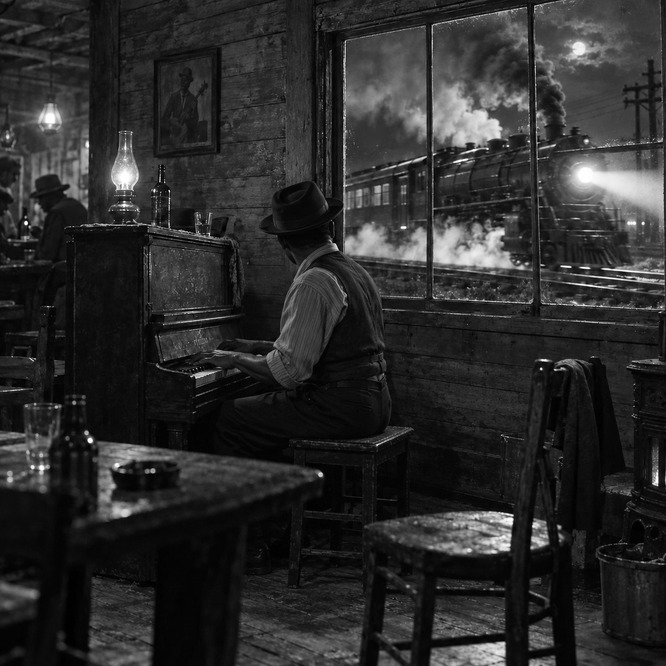
Blues music is a child of the railway age; many of its lyrics tell of the history and stories that unfolded along the tracks. For more than a hundred years, the railroad has held a firm place in this musical world, ever since the early travelling blues musicians from the Southern United States headed north as train-hopping “hobos”, and the steam train became a symbol of departure and the hope for freedom.
The railroad blues themes that emerged during this period established a musical tradition of their own, one that creative musicians continue to develop to this day. The form of blues that truly brings the steam train to life in the mind’s eye, with its rolling rhythm, is piano Boogie Woogie. The music is almost onomatopoeic: the rolling bass lines of the left hand evoke the rhythm of the wheels, the drive of the locomotive and the clatter of the rails. Wild chord progressions, trills and tremolos in the right hand recall the thunder of the exhaust beats, the hissing of steam and the sound of the whistle. The dark tones of blues melodies paint pictures of huge black, soot-covered engines, heavy freight trains, night expresses ...
Just like a steam locomotive, all of this is brought to life at the piano through genuine hands-on work. It is no more the product of computer-controlled synthesizer artificiality than a steam locomotive is driven at the push of a button. “Long distances” challenge the pianist just as they challenge the locomotive and its crew – and a Boogie Woogie pianist, too, really has to put his back into it.
Axel Zwingenberger in his book